I am finishing up the letter “D” in our ABCs of Equine Nutrition. Then we move on to the letter “E”. So far I have ESCs (Ethanol Soluble Carbs), Electrolytes, Energy, Vitamin E and EMS (equine Metabolic Syndrome). Any others we should include?


I am finishing up the letter “D” in our ABCs of Equine Nutrition. Then we move on to the letter “E”. So far I have ESCs (Ethanol Soluble Carbs), Electrolytes, Energy, Vitamin E and EMS (equine Metabolic Syndrome). Any others we should include?

What is it and How is it Made?
Dengie is just another name for chopped hay. The name Dengie is actually a brand of chopped hay, one of the original manufacturers. The company Dengie pioneered the use of high temperature drying to conserve forage for horses in the United Kingdom. When the Dengie company was founded, it was the only producer of high temperature dried alfalfa. As research on equine nutrition confirmed the benefits of a high fiber diet for horses, a bunch of other feed manufacturers followed suit.
 Because of its origination some people refer to all chopped hay as “Dengie”. Kind of like how there are tons of search engines but everyone says “Just Google it” as if Google is the name for searching the web. I will discuss Dengie under the letter “D” even though it probably belongs in “C” for chopped hay or even “H” (hay) for that matter.

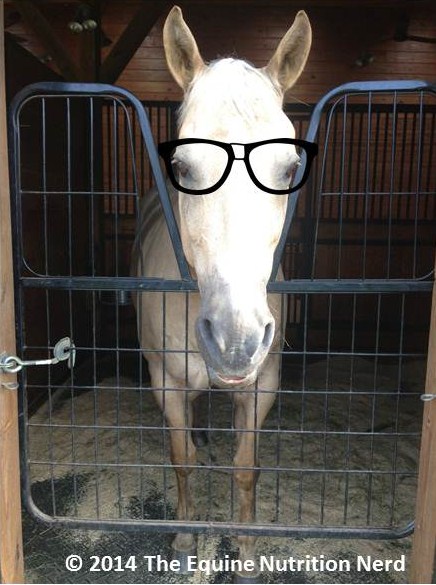
My client has a tough time keeping the weight off this 14 year old Quarter Horse gelding. It wasn’t so bad when he could be ridden 4-5 days per week but he was recently diagnosed with navicular changes and is limited to an occasional trail ride.
Sugar loves to eat. He is a big boy at 16 hands and 1,300 pounds. With his new restricted exercise his daily Caloric needs are now only for maintenance so around 17,000 (17 Mcal).
His owner has great pasture and takes good care of them with regular mowing and rotation to rest. Sugar’s normal schedule includes half a day turn out in one of these fields. In addition, his diet consisted of 2 pounds of senior grain and minerals plus a net full of orchard grass hay while he was in his stall.
Of course now that his activity level has been greatly reduced it’s obvious this diet needed adjusting plus the added weight wasn’t helping his foot issues. Adding all of the Calories in the different feedstuff we could see that Sugar’s daily intake was too high.
12 hours of grazing good pasture can equal as much as 10,000 Calories as a horse usually can consume on average 1-1 ½ pound of grass per hour and grass usually has around 900-1,000 Calories/pound.
We weighed the amount of hay he was getting and discovered it was at 1% of his body weight (almost 15 pounds) which is fine for a horse in work or one without good grass. This added 13,500 Calories (13.5 Mcal) to the grass Calories (10,000) and put him at 23,500 Calories without the grain!
When we added in the 2 pounds of Senior at 1,600 Calories per pound (3,200) he was at a total of 26,700 Calories per day, well over his maintenance needs and this will create health problems.
We started our changes with a no-brainer; we added a muzzle for half of the day during turn out. Sugar could still get out and feel like a horse, have a diet based on good forage plus get the additional benefit of moving around. A muzzle can reduce intake to one third of the amount they can consume without one.

We switched him from eating his hay from the ground to a slow feeder net and reduced the amount of hay to .50% of his BW (6 ½ pounds). I love slow feeding because it will take him all day to eat this lower amount which will keep him happy. The lower amount of hay will also reduce Calories.

We also switched his grain to a forage balancer pellet feed with lower Calories (1,100/pound versus the 1,600 in his Senior feed). We added the forage balancer to give him all the vitamins and minerals that might be missing plus extra biotin to help with his feet. He gets stressed if he doesn’t get some grain when everyone else does so we can give him some because it is fed at such a low rate that it adds very little in Calories.
After the changes if we add up Sugar’s intake:
6 hours of pasture with muzzle at 333 Calories per hour (1/3th of the Calories)= 1,998
6 hours of grazing at 1,000 Calories per hour = 6,000
6.5 pounds of hay at 900 Calories/pound = 5,850
2 Pounds of balancer pellet feed = 2,200
1,998 +6,000 + 5,850 + 2,200 = 16,048
Right where we should be. Remember to start your horse in a muzzle gradually and to tweak your ration/Calories according to time of year, quality of grass and hay, and other issues that might affect intake.
There is no reason why a horse that has a reduced Caloric requirement cannot live like a horse, out on pasture and with a little grain as a treat. Using slow feeding methods like nets and muzzles as well as the wonderful fortified “lite” feeds out now any horse can be healthy and happy!
If you would like your horse to be a part of the Equine Nutrition Nerd Herd just click here
Peace and Good Feed,
~The Nerd
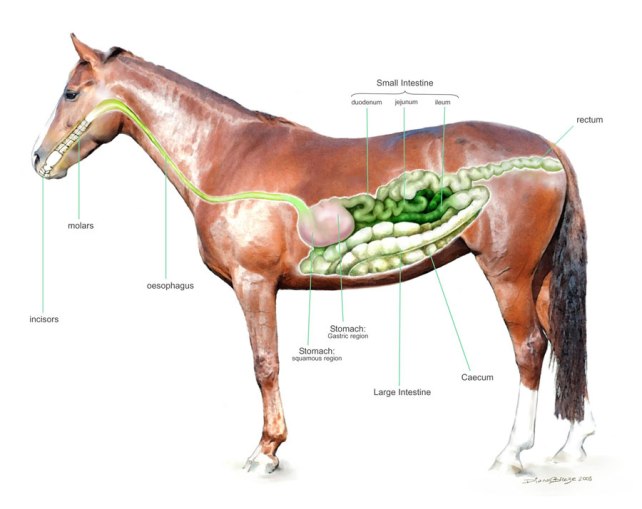
I know, I know, there are many places that already have really great descriptions and information on the equine Digestive system. But the ABCs of Equine Nutrition will be a book when we are done and a book on equine nutrition would not be complete without a review of the Digestive system and how it works. Plus it begins with the letter “D”. So if you are well versed in equine Digestion and how it works then you can wait for our next topic for the letter “D” and that’s Dengie. If not, let’s go!
To keep it simple (and I’m all about that) Digestion is basically the process of making food absorbable by the body to use as energy. It does this by dissolving it and breaking it down into simpler chemical compounds. In the horse this is done through the action of enzymes in the foregut (stomach and small intestine) and fermentation in the hind gut (cecum and large intestine).
When Digestion works properly the nutrients from the broken down feed can be absorbed and provide the fats, carbohydrates, amino acids (protein), vitamin and minerals for the horse to use to live, grow, work, etc. These nutrients can be used right away or stored for future demands.
 The Equine Nutrition Nerd
You must be logged in to post a comment.